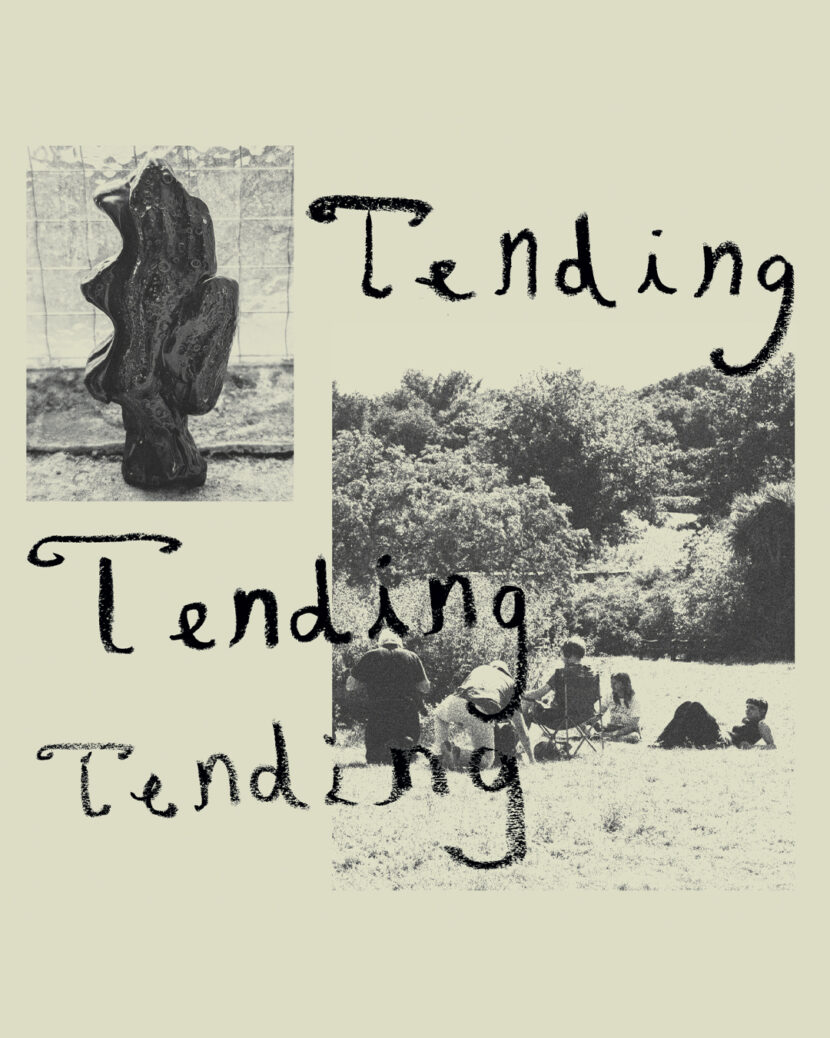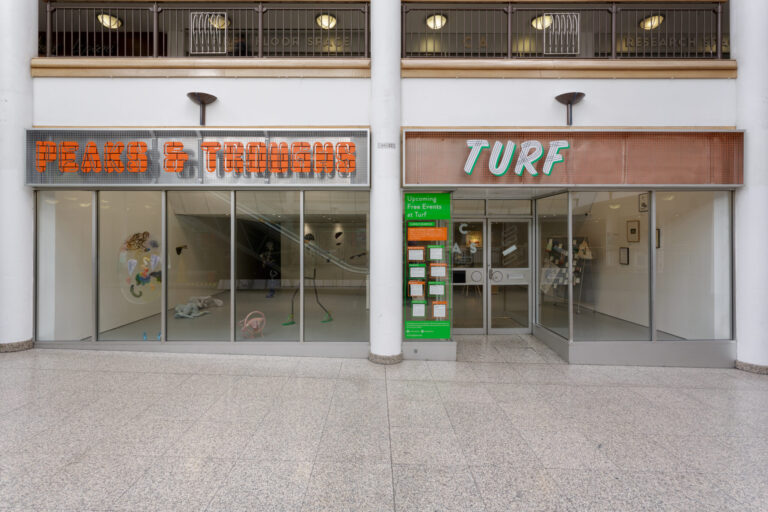

I recently visited Turf Projects in Croydon to explore their latest exhibition, Tending, inspired by ideas formed at the public programme & art gathering At the Meadow’s Edge, which took place across green spaces in Croydon.
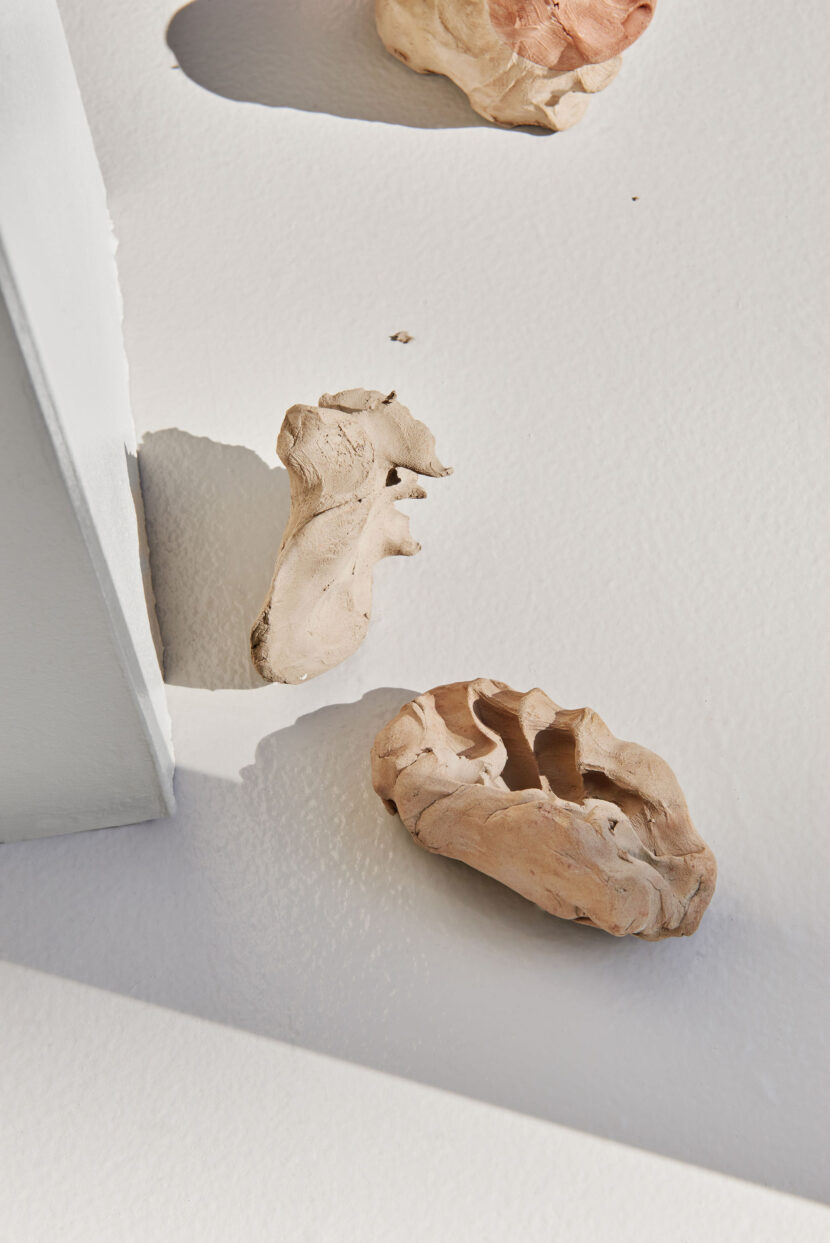
At first glance, they appear to be cocoons. Little brown pods that grubs could be hiding inside, preparing to transform into species of angel insects that don’t yet exist. They also remind me of empanadas, South American pastry parcels given shape by their baker’s palm.
A station tucked in the corner encourages me to make my own. I prize a chunk of raw ochre clay from a hefty plastic bag. It’s sticky in my hand. I lift it to my nose, take a deep inhale of its earthy, tangy musk. I roll it into a ball, stretch it, warm it with my skin. The text box informs me I can construct anything I wish, but for some reason, the only shape that naturally comes to mind is that of my own hand. I press down on the clay ball and create something akin to a ribbed chilli pepper, tapering the tip into a slight curl. The lines unique to my skin have left a subtle pattern. I gently place my progeny onto the shelf, next to several other anonymous works. Together, they resemble a forest floor littered with cicada rusks. At once, I feel larger and smaller than I did before. Recently, my nervous system has been inflamed, and I have found myself prone to panic. As I wash my hands in the silver bowl of warm soapy water, I steal a moment of calm.
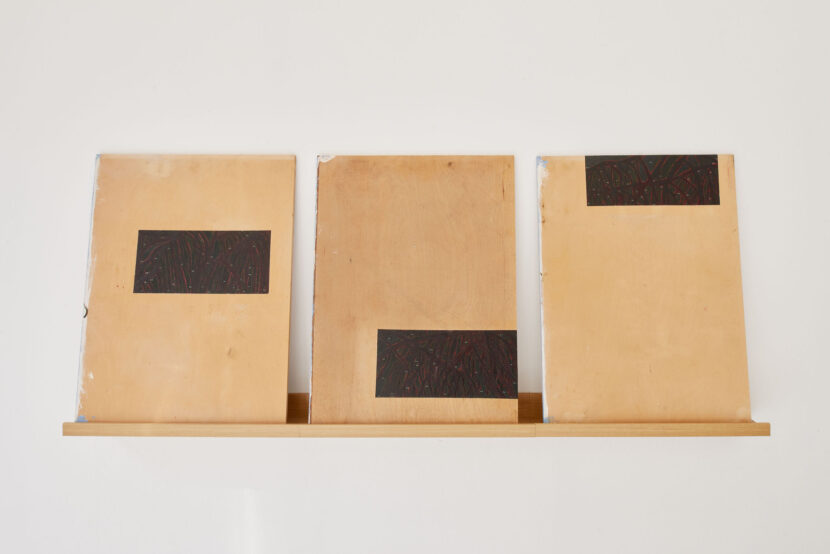
These paintings immediately unsettle me. Haunting black, red and green mangroves, with hundreds of eyes. Are the eyes those of creatures hiding in the trees, or do they belong to the trees themselves? The painting is looking at me more than I’m looking at it; I feel the need to hide myself.
I read Osborne’s accompanying pamphlet, and learn that the mangroves are inspired by an alien species from Octavia Butler’s novel Dawn. The Oankali do not need eyes to see. Osborne cannot help but bear witness to the genocides in Palestine and Sudan, cannot look away. The mangrove paintings direct the intensity of this gaze onto me. Osborne spent time with mangroves in Nilwella, Sri Lanka last year, mourning the loss of half the species’ population in the last 50 years. There is an aching sense that Osborne is attempting to keep the trees alive through their art, which in turn reaches towards its audience. Towards me. Our roots meet somewhere in the middle, a rhizome of energy aimed in the same direction, against all that is wrong in the world.
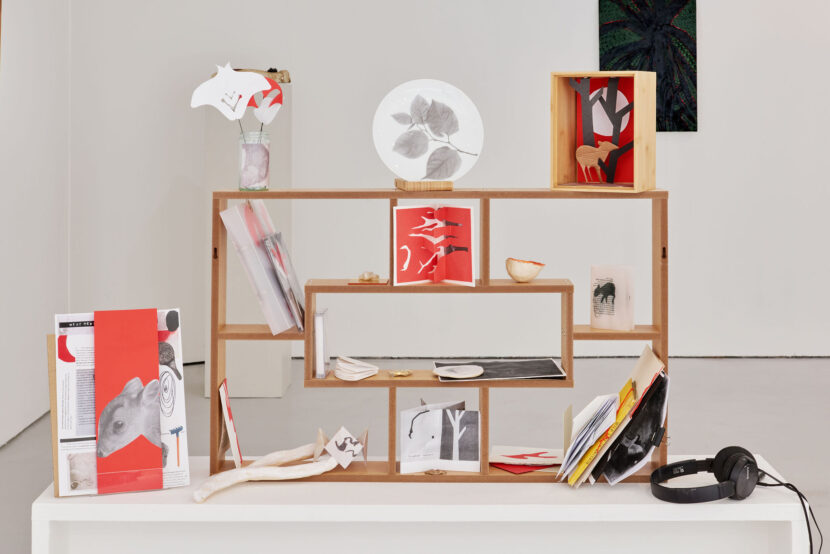
Which animals are deemed pests, ostracised from the realm of acceptability? Lyon has focused on one in particular, the muntjac deer, labelled ‘invasive’. Of course, there are arguments to be made that certain species disrupt local ecosystems, and can lead to imbalance. But the animals themselves are innocent and unaware of the damage they cause. The fault instead lies with humans who have brought animals to environs they should never have seen.
In New Zealand, tourists can go possum hunting to help cull the unwanted population. An environmental issue turned into a blood sport. Lyon has created an archive, a miniature library that explores themes of Britishness, xenophobia and conservation bias. I see someone sitting cross-legged on the floor, scribbling away on a piece of paper, soon to be added to the collection. An impromptu craft session, open to anyone. I browse muntjac-related literature – self-published pamphlets and zines. One is a playful collage of paper cut-outs of flora and fauna alongside quotes about DEI, wokeness, and microaggressions. I walk on from this section with a sense of satisfaction, that no animal is too small or vilified to be placed in a spotlight.
On a screen, a woman is spinning with a metal square at her waist, like the world’s worst made hula hoop. In the background, a TV in a living room, tuned to Channel 4.
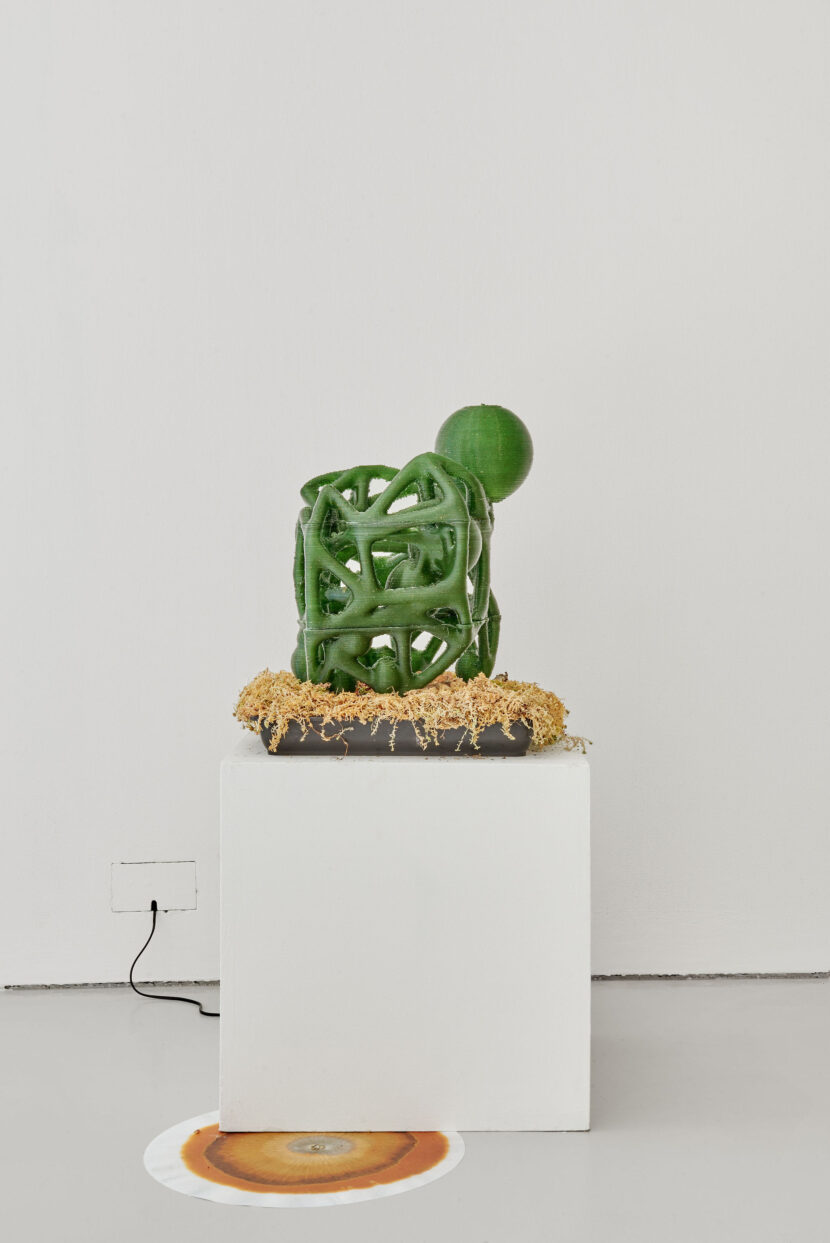
On an oldschool MP3 player, I listen to croydon_transient_01, some alien insect clicking. I can’t decipher this language, a transmission from a distant galaxy, life forms striving to communicate with me. Even though I know it was recorded just down the road, and comes from a natural substance I walk past every day without thinking. Selby has placed contact microphones in the ground, alchemised soundscapes from soil samples. One of these otherworldly scores, that of sphagnum moss, has been realised into a sculpture, 3D-printed with hemp. A hybrid of organic matter and cutting-edge technology, this sphere is formed of spiralling tendrils of emerald string. The locally-based sound artist’s aural experiments have revealed the music hidden under the ground, both cinematic and intimate. My attention is drawn to the most minute life-forms, and I experience them in a way I never imagined I could: sonically. These beguiling noises will stay with me for the rest of the day, an ethereal tinnitus.
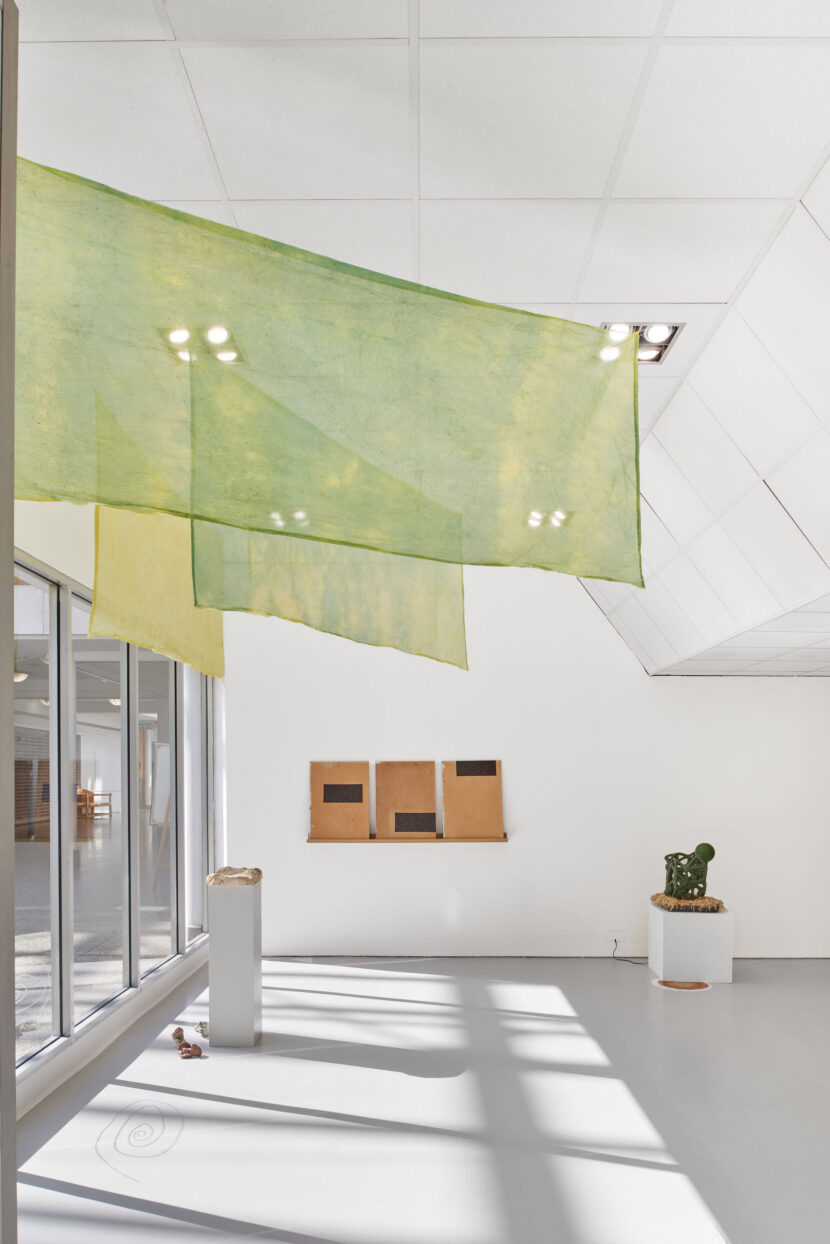
I left Turf Projects with a profound sense of interconnectedness. The four artists’ work existed in conversation with each other. They encouraged my active participation; I became part of the process. This is truly a vital community space, not just for Croydon, but for London as a whole.
The themes of the Tending exhibition brought to mind a conversation I’d had last month with my friend Oscar Wilson, a paleontologist at the University of Helsinki. Recently whilst on placement in Australia, he found an echidna fossil sitting unnoticed in a drawer. He and his team were able to date it as the world’s oldest echidna remains. Sometimes incredible discoveries are right under our noses.
He told me about a nature reserve called Pleistocene Park in Northern Siberia where giant tanks pretend to be wooly mammoths, knocking down trees,. It is part of an attempt to return the landscape to how it was a million years ago. They will rewild it with megafauna and reintroduce mammals to regulate its climate.
Is it better to mourn what’s gone or engineer its return? We are more aware of loss now than ever before. In the 20th century, the US lost its most common bird (the passenger pigeon) , its most common insect (the Rocky Mountain locust) and came close to losing its most common mammal (the American bison). Extinction has reshaped what it means to be common, ordinary. The sky used to be so full of noise and movement, even my parents remember it differently.
Last week I was watching Countryfile with my dad. A baby goshawk was devouring a red squirrel. The presenter described it as ‘intestine spaghetti.’ I felt a strange burst of love for my dad. I remembered watching a YouTube video of the last bird of its species calling for a mate that will never come.
Oscar told me about ‘plant blindness’ in the field of natural sciences – how flora is often overlooked in favour of fauna. Carnivorous plants draw intrigue due to their proximity to animal behaviour. I have a dream I’m a tropical pitcher plant, holding a fly in my bulbous belly. For a moment, just before my acid dissolves my prey, I feel its heartbeat as if it’s my own. The only heartbeats I have ever felt inside me belong to others. Most people in the world will never see me as equally alive.
Oscar’s research has led him to find examples of breakages of bonds in the fossil record. Moments where symbiosis has failed, with one partner dying. If we lose the flea that drills into an armadillo’s scales, we lose the armadillo. Oxpeckers eat ticks and drink blood from rhinos and zebras. Remoras clean parasites and dead skin from the underside of sharks in exchange for a free ride. Interdependence, mutualism – there are countless examples of animals who need each other to survive.
With Tending, it is clear that there is a symbiotic relationship between artists and the natural world. These artists need nature to make art about, and nature needs these artists to represent it, to give it a voice. Tending gives a voice to ignored and downtrodden species – muntjac deemed pests, mangroves decimated despite providing ideal habitats, and moss you’d walk past every day without realising the music it stores inside its cells.
Image credit: Mitsi Moulson
Harper Walton is the author of Midnight Movies (Femmesocial Press) The Ballad of a Bloodless Hangnail (New Words Press) and Common Only in Name (Rival Press). Their work has been featured by 1883 Magazine, Whitechapel Gallery, Venice Architecture Biennale and more.
Share: